
Dead and Dying Tree Removal in Abilene, TX
A standing dead tree does not fail on a schedule. Once one is inside falling distance of the house or the driveway, it stops being a landscape problem.
Dead, Dying, or Just Late
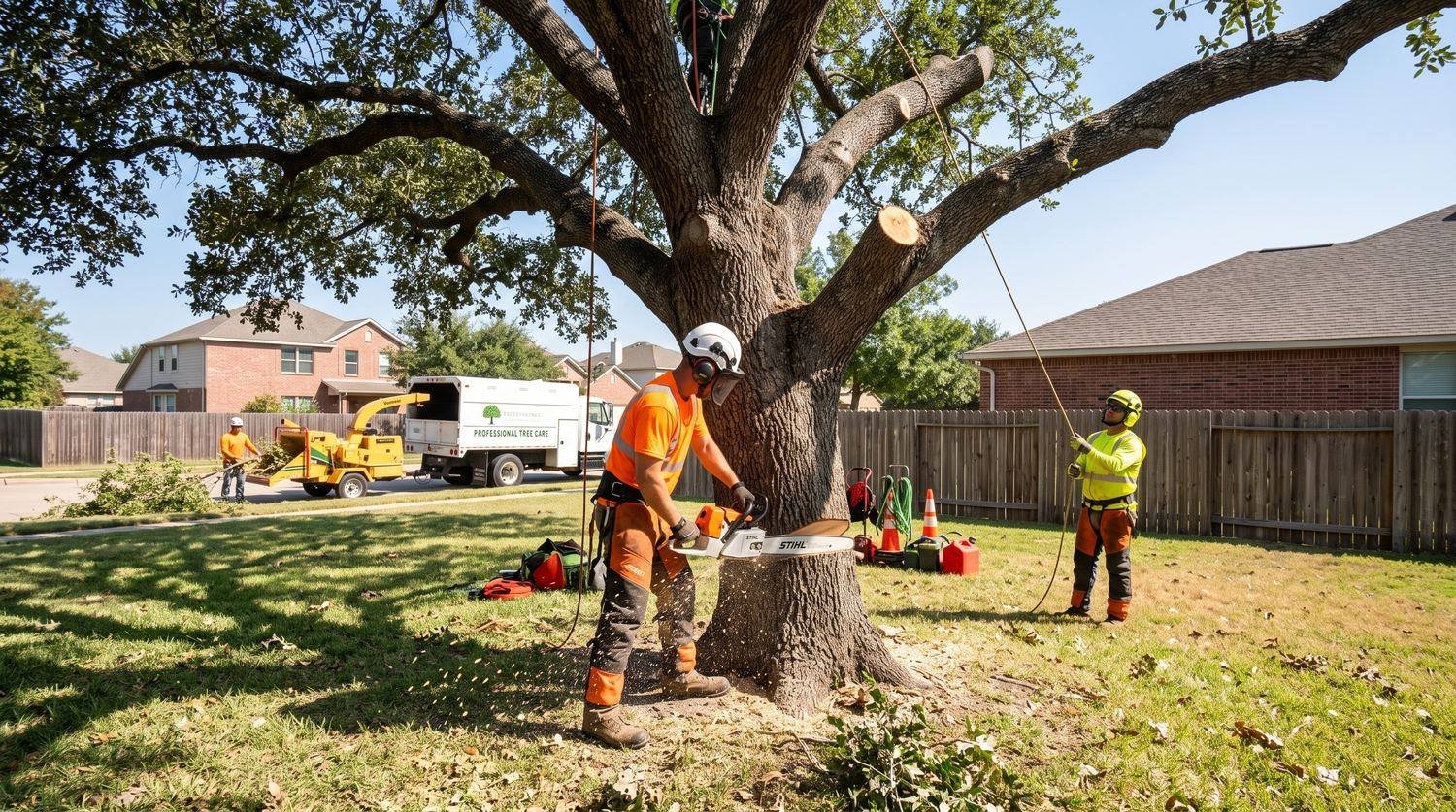
Plenty of trees that look finished in March are only slow. Ten minutes with a pocket knife separates a takedown from a watering plan.
Three checks:
- Scratch the bark. Scrape a sliver off a pencil sized twig. Texas A&M Forest Service puts it plainly: green, moist tissue underneath means the tree is still hanging on, and no green moist tissue means it is likely dead. Check high, low and on several sides, since a tree can be dead in the top and alive below.
- Check the buds. Live buds are plump and firmly attached. Dead ones crumble or pull off with no resistance. The honest version of this test is late spring, once the rest of the street has leafed out.
- Bend a twig. A living twig bends a long way before it breaks. A dead one snaps clean and dry.
Drought is the recurring pressure here and its effects run late. Texas A&M Forest Service notes that drought kills the fine feeder roots a tree uses to take up water, that stress lingers for years after soil moisture returns, and that scattered trees keep dying for several years afterward. A tree that failed this spring may be answering a dry summer two years back.
Get a Free Dead Tree Removal Quote
Send one photo showing the whole tree and one of the base, and tell us roughly how long it has looked like that.
- Free, no-obligation estimate
- Quotes from an independent local tree service
- Brush chipped and hauled, area raked clean
- We will tell you if it can safely wait
Your request goes to an independent local tree service, which contacts you with a quote. Big Country Tree Pros does not do the tree work itself.
Why a Dead Tree Is Harder Than a Live One
Most people expect a dead tree to be cheaper. No leaves, less weight, less to carry out. It frequently runs the other way, and the reason is what dry wood does under load. Live wood is fibrous and flexible, so it creaks and gives warning. Dead wood does none of that. A limb dead two seasons lets go with no sound and no bend, at the point you were counting on.
That changes the method. A climber works on trust: the tie in point, the branches used as footholds, the limb a rigging line is anchored to. On a tree standing dead a couple of years none of that can be assumed, and some cannot be tested at all. So the work moves off the tree. Where access allows it comes down from a lift. Where it does not, it comes down in more pieces, smaller ones, more slowly.
The base is the other unknown. Shelf fungus at the trunk flare, bark sliding off in sheets, a hollow that swallows your arm, or soil cracked and lifted on one side all point at decay in the root plate. Felling depends on a strip of sound hinge wood holding while the tree goes over. If that hinge is punky the tree does not go where the notch says, and the job becomes a dismantle whether the yard is open or not.
Does It Have to Come Down Right Now?
That depends on what is underneath it, and we would rather say so than sell a removal that does not need doing.
| Where it stands | What we usually say |
|---|---|
| Inside falling distance of the house or garage | Remove it. Not a seasonal decision |
| Over a driveway, vehicle, walkway or play area | Remove it |
| Near the service drop or an overhead line | Remove it, coordinated with the utility |
| On a fence line or leaning at a neighbor | Remove it, and talk to the neighbor first |
| Open pasture, nothing in reach | Reasonable to leave. Look again each year |
That last row is a real option. Texas Parks and Wildlife notes that standing dead trees are used heavily by woodpeckers for foraging, nesting and roosting, and that secondary cavity nesters, owls, squirrels and bats depend on the holes woodpeckers leave. The same guidance sets the limit: do not let a snag rest against a structure or hang over a neighbor’s fence or vehicle. Near a building the Forest Service does not hedge, and says dead trees should be felled and removed as soon as possible where they are a hazard.
Dead trees also get harder on their own timetable. Bark sloughs, limbs shed, decay works toward the base. A tree that can be climbed this spring may be a lift job by fall.
What Moves the Price
| Factor | Why it matters |
|---|---|
| How long it has been dead | The longer it stood, the less the wood can be trusted |
| Condition at the base | Decay in the root plate takes felling off the table |
| What is underneath | Open ground is fastest. A roof or fence means roping every piece down |
| Access for equipment | Whether a lift and chipper reach the trunk, or it comes out by hand |
| Size and haul volume | More wood is more cutting and more material to move |
| Stump | Quoted separately, since not everyone wants it ground |
After It Is Down
Brush is chipped and hauled, trunk wood is cut into rounds, and the area is raked and blown clean. Grinding the stump on the same visit beats a return trip, covered on the stump grinding page. Wood from a recently dead tree is often already seasoned, while wood gone soft is better hauled off.
Handling some debris yourself? The tree debris disposal page covers local options. City brush rules change, so confirm current rules with the City of Abilene. We work Abilene out through Wylie, Tye, Clyde, Baird, Buffalo Gap and Merkel, listed on the service areas page.
Dead Tree Questions
How do I tell if my tree is dead or just late leafing out?
Scratch a sliver of bark off a small twig. Green and moist underneath means living tissue, dry and brown means it is dead. Check several heights, then confirm in late spring.
Is a dead tree cheaper to remove than a live one?
Usually not. Dead wood is brittle and fails without warning, so a climber cannot trust the structure. It often comes down from a lift or in smaller pieces, which takes longer.
My tree is dead but nowhere near the house. Do I have to remove it?
Not necessarily. A snag with nothing inside falling distance is useful to woodpeckers, owls, squirrels and bats. Check it yearly. One near a structure is different.
There are mushrooms growing at the base. Does that matter?
Yes. Fruiting bodies at the trunk flare usually mean decay in the trunk or root plate, which means the tree cannot be relied on to fall where a notch points it.
Can you still climb a dead tree?
Sometimes, if it died recently and the wood is sound. After a season or two standing dead we plan on a lift or a ground up dismantle, since anchor points cannot be verified.
Can we keep the wood for firewood?
Yes, and it saves us a trip to the dump. Recently dead wood is often already seasoned. Punky wood will not burn well.
Ready for a free quote?
Takes about a minute. No obligation, no pressure.