
Storm Damage Tree Cleanup in Abilene, TX
Trees on roofs, across driveways and through fences. We take the load off carefully, in the right order, and haul the mess away.
The First Hour After a Tree Comes Down
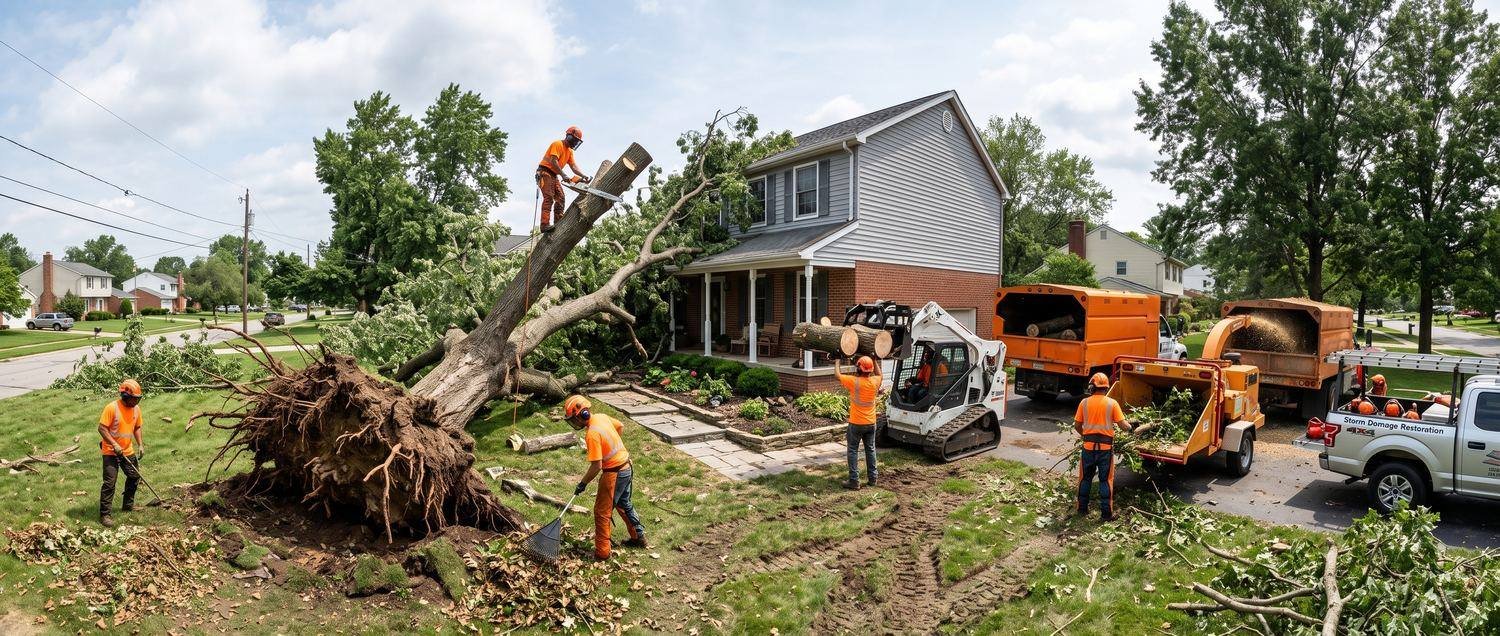
Storm damage and emergency tree cleanup in Abilene tends to arrive on the worst possible schedule, at night, in the rain, with a limb through the fence and half a pecan on the garage. What you do in the first hour matters more than how fast anyone gets a saw running.
- Get everyone away from the tree, and out of any room underneath it
- If the tree is touching a power line, stay back and treat every line as live. Do not touch the tree, the fence it landed on, or the wet ground around it. Call your utility, and call 911 if a line is down across a road
- Smell gas, see sparking, or notice the house structure moving? Get out and call 911
- Photograph everything before a single cut. Wide shots of the whole tree, close ups of the damage, the inside of any room that took water
- Stay off the tree. Do not climb it, and do not run a chainsaw on a trunk that is holding weight
- Cover what you can safely reach from the ground, and leave the roof to someone with the right gear
Get Help With Storm Damage
Send photos from a safe distance and tell us what the tree is resting on. That tells us what equipment to bring and how quickly we need to be there.
- Free, no-obligation estimate
- Trees on structures move to the front of the line
- Photos first, so your insurance claim has what it needs
- Brush chipped and hauled off, yard raked clean
Your request goes to an independent local tree service, which contacts you with a quote. Big Country Tree Pros does not do the tree work itself.
Why Storm Work Is Different
A healthy standing tree behaves predictably. A storm damaged one does not. The wood is loaded in directions it was never meant to carry, and cutting in the wrong place lets all of that go at once.
| Hazard | What happens |
|---|---|
| Spring poles | A bent sapling pinned under the fallen tree stores energy like a drawn bow. Cut it wrong and it whips back faster than anyone can move |
| Hangers and widowmakers | Broken limbs lodged up in the canopy, invisible from below. A bump on the trunk drops them on whoever is underneath |
| Tension and compression | A trunk lying across a fence is stretched on one face and squeezed on the other. Cut the compression side and the bar pinches. Cut the tension side and the log splits or rolls |
| Unstable root plates | A partly uprooted tree is a hinge holding tons of soil. Take weight off the top and the plate can slam back into the hole |
That is why storm jobs go slower than they look like they should. Half the work is deciding the order of cuts before anyone makes one.
What the Big Country Throws at Trees
We see four patterns of storm damage around Abilene, and they fail trees in different ways.
- Straight line winds. Thunderstorm outflow crossing open country hits hard and from one direction. It snaps tops out of pecans and pushes over shallow rooted trees in ground already soaked by the same storm
- Hail. It strips leaves and bruises bark. The tree looks fine in July, then declines the next year as those wounds let decay in
- Ice. A winter ice event loads every twig with weight the tree never carries otherwise. Brittle species like hackberry, Arizona ash and Bradford pear come apart first
- Drought. The most underrated. Roots die back through long dry spells, and the tree that has quietly lost anchorage over two summers is the one that goes over in the next hard gust
Our soil adds to it. Clay shrinks and cracks in drought, then several inches of rain in an hour saturate it and the ground gives up its grip on the root plate.
Tree on a House, a Fence or the Driveway
Not every storm call is an emergency, and it helps to be straight about which is which. Here is roughly how these get sorted.
| Situation | How it gets handled |
|---|---|
| Tree on the house | Top priority. Weight comes off in rigged pieces so nothing drops through the roof twice. Rain in the hole makes every hour count |
| Tree blocking a driveway or road | Next. The first pass is a lane wide enough to get vehicles in and out, then the cleanup follows |
| Tree on a fence or down in the yard | Real work, but rarely an emergency. It gets scheduled in daylight, which is safer and cheaper. Livestock loose through a downed fence moves it up the list |
| Hanging limb over a walkway | Urgent even though nothing has fallen. A hanger is waiting on wind, so rope it off and keep people out from under it |
Storm calls come from all over, from neighborhoods in Abilene and Wylie out to Tye, Merkel, Clyde, Baird and Buffalo Gap. Rural jobs give us more room to work, though they tend to involve bigger mesquite and pecan.
About Insurance
Policies vary and we are not your insurer, so treat this as general background and confirm the details with your own agent.
In broad terms, most homeowner policies address a tree that damages a covered structure such as a house, garage or fence, and coverage often includes reasonable removal of that tree. A tree that falls in the open yard and hits nothing is treated differently under many policies. Whose tree it was matters less than people expect, since claims usually run through the policy covering the property that got hit.
What to document
What We Do When We Get There
The first thing is a walk around with our heads up. Where is the load, what is hung up, what is under tension, what moves when the first piece comes off. Then the area gets secured so nobody wanders under the work.
The order of the cuts
From there it is a sequence, not a race. Hangers come out first. Pieces over a roof or fence get roped and lowered rather than dropped. Tension is released with relieving cuts in the right order. Trunk wood is blocked down to sizes we can move, brush is chipped, and the yard gets raked and blown before we pull out. If a stump is left behind, grinding it on the same visit is cheaper than a separate trip.
Work Worth Doing Before the Next Storm
Most storm damage we clean up was predictable. The limb that came through the roof was dead last summer. The tree that went over had a cavity at the base you could see from the driveway.
- Get deadwood out of the canopy and reduce end weight on long, heavy limbs
- Look for conks at the base, cracks in a main union, and soil heaving on one side of the trunk
- Take down trees that are already failing, before the wind picks the timing
- Water established trees through long dry spells. Roots that survive drought hold in wind
- Do not let anyone top a tree as storm proofing. The regrowth is weakly attached and fails harder later
Regular tree trimming is the cheapest storm insurance there is. To have a tree looked at before the next round of weather, send us a photo.
Storm Damage Questions
A tree just fell on my house. What do I do first?
Get everyone out from under it, stay clear of any lines the tree is touching, and call your utility if lines are involved. Then photograph everything before a single cut and call us with those photos.
Do you handle emergency calls?
Yes. Trees on structures and trees blocking access move to the front of the schedule. We will tell you honestly when we can be there rather than promise a time we cannot hold.
Can I cut it up myself?
Small limbs on the ground, sure. A trunk under tension, anything hung up in a canopy, and anything near a line are how people get hurt. Storm damaged wood does not cut like firewood.
My neighbor’s tree fell on my fence. Who pays?
Policies vary and your insurer is the one to ask. Claims generally run through the policy covering the property that was damaged, whatever the tree was rooted in.
Will you tarp my roof?
We clear the tree and the debris. Roof repair belongs to a roofer, and we work in whatever order lets them get up there soonest.
Do you haul everything off?
Yes. Brush is chipped, trunk wood is removed unless you want it for firewood, and the work area is raked and blown before we leave.
Ready for a free quote?
Takes about a minute. No obligation, no pressure.